
Global gold demand hit an 11-year low in 2020 at 3,759.6 tonnes, mainly due to a weak October-December quarter and the COVID-19 related disruptions across the world driving a muted consumer sentiment throughout the year, the World Gold Council (WGC) said in a report. The overall consumer demand during 2019 was at 4,386.4 tonnes, while in 2009 the overall demand was at 3,385.8 tonnes, according the WGC's 2020 Gold Demand Trends report. Global gold demand dropped by 28 per cent year-on-year (YoY) to 783.4 tonnes in the fourth quarter compared to 1,082.9 tonnes during the October-December period of 2019, the report stated.
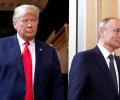
The stagnation in US-Russia relations does not augur well for New Delhi's strategic interests, says Harsh V Pant and Raj Kumar Sharma.
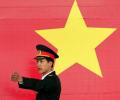
Modi's Vietnam visit is timely and crucial for several reasons. First, Vietnam lies at the heart of India's vision for Southeast Asia as also its 'Act East' policy. India also wants to boost its defence exports to friendly countries. And it is looking to increase trade between the two countries will now is only $7.83 billion, says Dr Rahul Mishra.

'Over the last two decades, the India-French relationship has grown steadily, no major political difference having darkened the sky between Paris and Delhi,' says Claude Arpi.

This is the joint statement issued by the ministry of external affairs on the visit of US President Barack Obama to India.

The death toll also saw a record single-day increase of over 350 fatalities to move closer to the 8,500-mark, more than one-third of which have been recorded in 11 days since June 1 -- the day that marked the beginning of a phased exit from most restrictions imposed under a nationwide lockdown with effect from March 25.

'While economic ties are making incremental progress, it is in the security and strategic domains that the India-Japan synergy is more compelling,' says Dr Rajaram Panda.

'Even if the national security framework is to be threat-based, then the division of security threats between Pakistan and China is absurd. The two threats are one.'

India is no longer shying away from playing a role on the regional and international stages and is willing to don a bigger role in regional politics. It is showing traits of a responsible stakeholder in the regional security dynamics, says Dr Rahul Mishra.

With facts and figures, the CAG report has highlighted how Gujarat was far from a role model for states across India, and that the progress made in this province in western India in improving agriculture, education, healthcare and empowerment of women and children, was not exactly creditable, says Paranjoy Guha Thakurta.

President Xi Jinping's visit may put relations between India and China on a new trajectory

'... That they should emerge as role-models to be emulated by the fellow countrymen; and that the middle classes should not stick only to hate-filled and scornful criticism and condemnation against the state of affairs,' remembers Mohammad Sajjad.

Here's the full text of President's Ram Nath Kovind's address to the joint sitting of both houses of Parliament on the first of Budget Session 2022.

The Forbes 30 Under 30 list is harder to get into than Stanford or Harvard University. Meet the desis who made the cut this year.

'There are so many dimensions to history that we need to attend to: We need more space for local and regional histories; we need to delve into the histories of particular communities; we need to emphasise gender history and environmental history.' 'We need to think about India's history beyond India's current borders.'

The Delhi metropolitan area has one of the highest concentrations of population in the world, and suffocating the people of the area on an annual basis should be treated as a crime against humanity, especially when the cause for such suffocation can be controlled, says Arvind Kumar.

One thing Beijing must understand is that India is not obsessed with being a threat to China but only wants a rightful place for itself in the world, says Sanjeev Nayyar.

China continues to hold out on fingering Pakistan as the 'mothership of terror,' declaring Masood Azhar a terrorist at the UN, and India's membership of the NSG, says China expert Srikanth Kondapalli.

'Both India and Japan can find themselves in a win-win situation if they draw some lessons from each other's strengths,' says Dr Rajaram Panda.

Amid souring ties, the president visited Beijing for three days. On his return to India, a hope of better ties has arisen, says senior correspondent R Rajagopalan, who travelled with Pranab Mukherjee to the Asian superpower.

'We rarely choose to fight when the threat is still a nascent threat. When we do fight, we fight when the invaders reach Panipat and are preparing to knock on the gates of Delhi.'

US congressional leaders on trade and finance wrote to the US International Trade Commission calling for a second investigation into India's 'unfair' trade practices, detailing any changes under Modi.

'Our policy seems to be to give away part of J&K, even though we are entitled to the entire state.' 'The Congress has done so, and the BJP is following the same policy.' 'No one is applying their mind to the legal position.' 'Kashmir is not a part of Pakistan under its own constitution.'
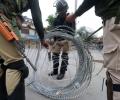
'If Islamic extremists regain power in Afghanistan, Pakistan will lead them to Kashmir as a fighting arena again. India needs to fortify Kashmir and prepare against these Islamic extremists before they come again.'

Moving ahead with their new mantra -- Chalein Saath Saath: Forward Together We Go -- Prime Minister Narendra Modi and United States President Barack Obama on Tuesday vowed to deepen cooperation in every sector for the benefit of global stability and people's livelihoods over the next ten years.

Startups in India need low-cost debt for working capital, which is impossible to get.

'Fearlessness, courtesy, humour, wide interests and wisdom, deep commitment to science and technology, passion for the environment, objectivity and the ability to see many things through not only a national but also an international prism.'

"We are committed to building a new India. We have to do this as early as possible," he said.

I still believe that it is a good thing that think tanks are mushrooming in Delhi. They provide a platform for discussion, even if they shed more heat than light. With Parliament almost incapable of serious debate, informed discussion and civilised discourse, where does this nation get its intellectual churn, asks Mohan Guruswamy.

Was the Modi-Obama summit the panacea for all that troubles the India-US relationship?


What will it take to get India's poor broadband penetration to be seen as a problem and not as a condition, thus enabling real, serious e-commerce to take off in India?

'Let me talk about young Indian startups with their hearts in the right place and how they are proving that innovations that represent 'affordable excellence' -- breaking the myth that 'affordability' and 'excellence' cannot go together -- is indeed possible!' says Dr R A Mashelkar, the eminent scientist, in this fascinating feature.

'India is no longer the India of the '70s and the '80s.' 'It's a large country with the fastest growing economy.' 'In working with India, you just can't go and humiliate the nation publicly.' USIBC President Mukesh Aghi tells Aziz Haniffa/Rediff.com about how he advises American companies to do business with India, what he thinks of Modi's government and the way forward for the India-US relationship.

'The book has immense value because it reveals the inner workings of the think-tank which appears to provide facts and insights to Modi, though he himself takes the final decisions and articulates them in his characteristic rhetorical style,' says Ambassador T P Sreenivasan.

The White House said it has 'a large body' of evidence indicating that the Assad regime was responsible for the April 7 chemical attack in Duma.

With over 135 news channels, about a third owned by politicians and real estate guys, the news TV market is a nightmare, says Vanita Kohli-Khandekar.

'It is a pattern of behaviour of the Chinese that whenever a Chinese leader visits India or an Indian leader visits China, some incidents take place.' 'When Modi visits China, we should look out for some similar demonstration by the Chinese.'
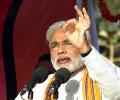
'Both reflect prejudice and short-sightedness peculiar to Mr Modi's way of thinking.'

Ameesha Joshi tells Harish Kotian/Rediff.com what made her and Anna Sarkissian devote much of the last 10 years on a movie on women's boxing in India.
